

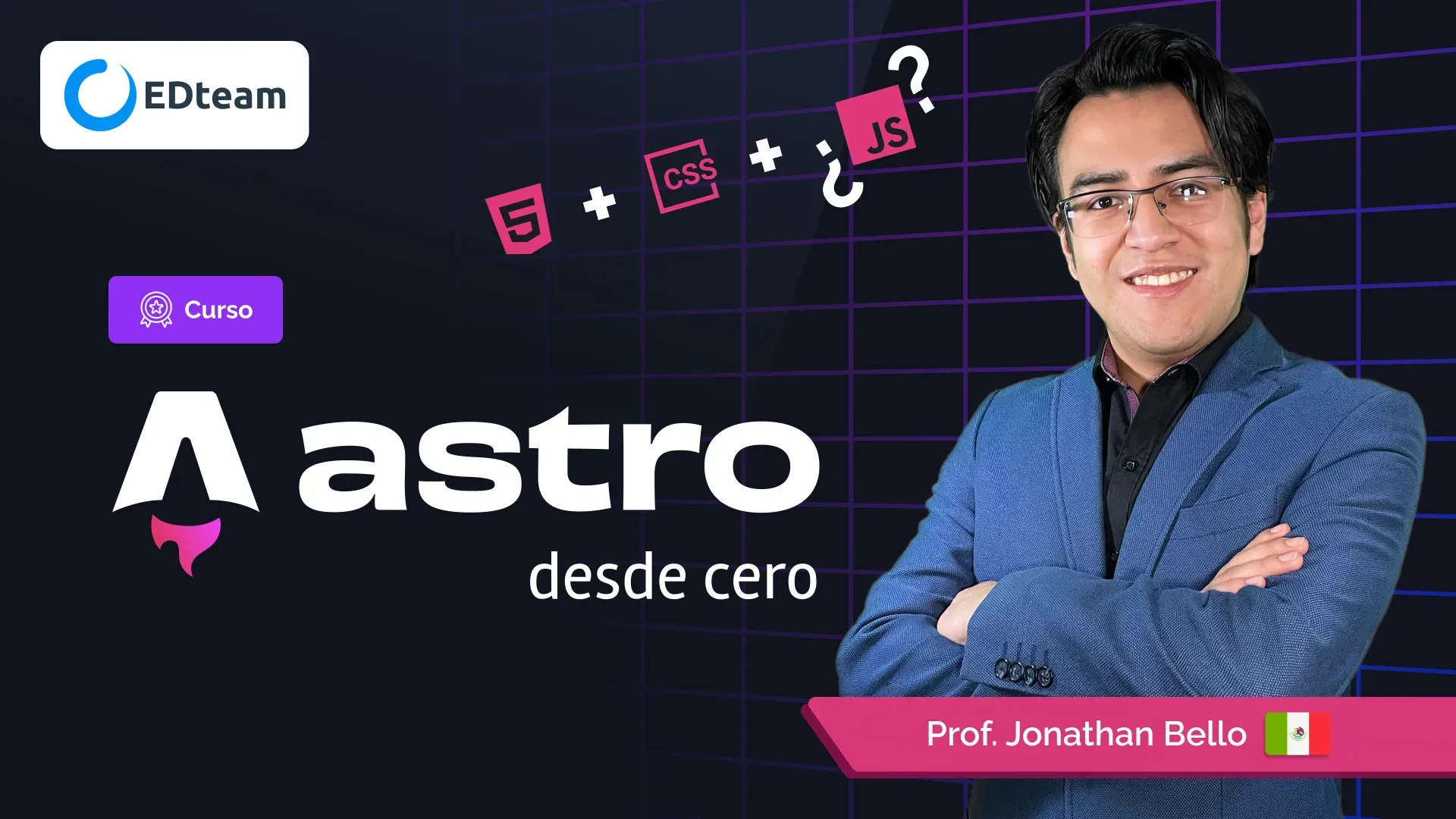
Astro from scratch at EDteam
June 1, 2026
An introductory Astro course taught at EDteam, born from an unexpected application and the need to turn real project experience into a clear learning path.
Context
Astro from scratch was my first published course at EDteam and one of the most meaningful experiences of my professional stage. I reached the platform at a moment when my responsibilities had become lighter, so I started looking for new paths: I applied to different opportunities, including my master’s degree, and also to EDteam’s teacher school.
The proposal came from a simple observation: EDteam did not have a dedicated Astro course, and I was already using the framework in real projects. Astro had become an important tool in my career, not only because I liked it, but because it had changed the way I built websites: faster, clearer and closer to the modern static web.
To enter, they asked me to prepare a test class. I chose to explain View Transitions, a topic I had already explored in projects like Tradeco and other websites where I did not use it superficially, but tried to understand how it could give static pages the feeling of a living application. I arrived nervous, simulated the class and ended up talking with teachers I had previously seen as distant references. In the end, they told me they liked my way of explaining and that I could practically start the next day.
That moment felt strange and beautiful at the same time. I had arrived thinking I was going to learn how to become a teacher inside the teacher school, not that they were already going to trust me with a course. But I also felt deeply excited: I was going to publish knowledge on a platform that had been part of my own learning process.
Course Development
EDteam had a very clear production workflow. They explained the process, asked me to build the syllabus in Notion and sent me lights, a tripod, a microphone and a green screen. That organization let me focus on what mattered most: ordering my experience and turning it into an understandable learning path.
I prepared the syllabus during several nights. I remember feeling almost like a writer, thinking about what I needed to present first, which concepts needed a foundation before reaching components, pages, content, styles, integrations and deployment. I did not want it to be a simple list of features; I wanted students to understand why Astro exists, what problem it solves and how they can use it to build real projects.
During preparation, Astro 5 was released. That changed part of the plan, because several decisions in the course would have been tied to a version that was about to feel outdated. I asked for more time to update the approach, and EDteam understood. I preferred to stop for a moment and do it properly instead of publishing a course that was born with technical debt from day one.
I also asked to expand the structure. The initial idea was to keep the course in fewer modules, but Astro needed more room to be explained calmly. In the end, I was able to organize it into more blocks and close with a final project, keeping it introductory but complete enough for someone to leave with a real foundation.
My Role
My work was to design the syllabus, prepare the examples, record the lessons and explain Astro from practical experience. It was not only about reading documentation: it was about translating what I had learned while building client websites, solving performance problems, migrating away from Gatsby, using Markdown content, taking care of SEO and taking advantage of Astro’s architecture.
The course also forced me to change positions. Moving from using a technology to teaching it requires another kind of clarity. It is not enough to know how to do it; you have to find the right order, anticipate questions, explain without showing off complexity and accompany someone who does not yet have the full mental map.
That was one of the most valuable lessons: discovering that I could explain well. Several people told me I knew how to speak, express myself and keep a class entertaining. For someone who has always wanted to be a teacher in one way or another, hearing that meant a lot.
Result
Astro from scratch became an important piece of my professional identity. The positive student reviews made me grateful because they meant the knowledge had actually reached someone. There were also harsh opinions, and that was part of the learning process: you cannot please everyone, and not every student arrives with the same expectations.
But seeing that most people found value in the course, that dozens took the time to rate it and that it reached a strong average, made me feel that the effort was worth it. It even became part of EDteam’s learning routes, sharing space with instructors I had admired before.
For my portfolio, this project represents more than a technical course. It represents the moment when my experience with Astro stopped being only a work tool and became shared knowledge. It was a way of giving back part of what I had received while learning.
0Comments are temporarily paused while moderation and spam protection are implemented.